History of Glasgow
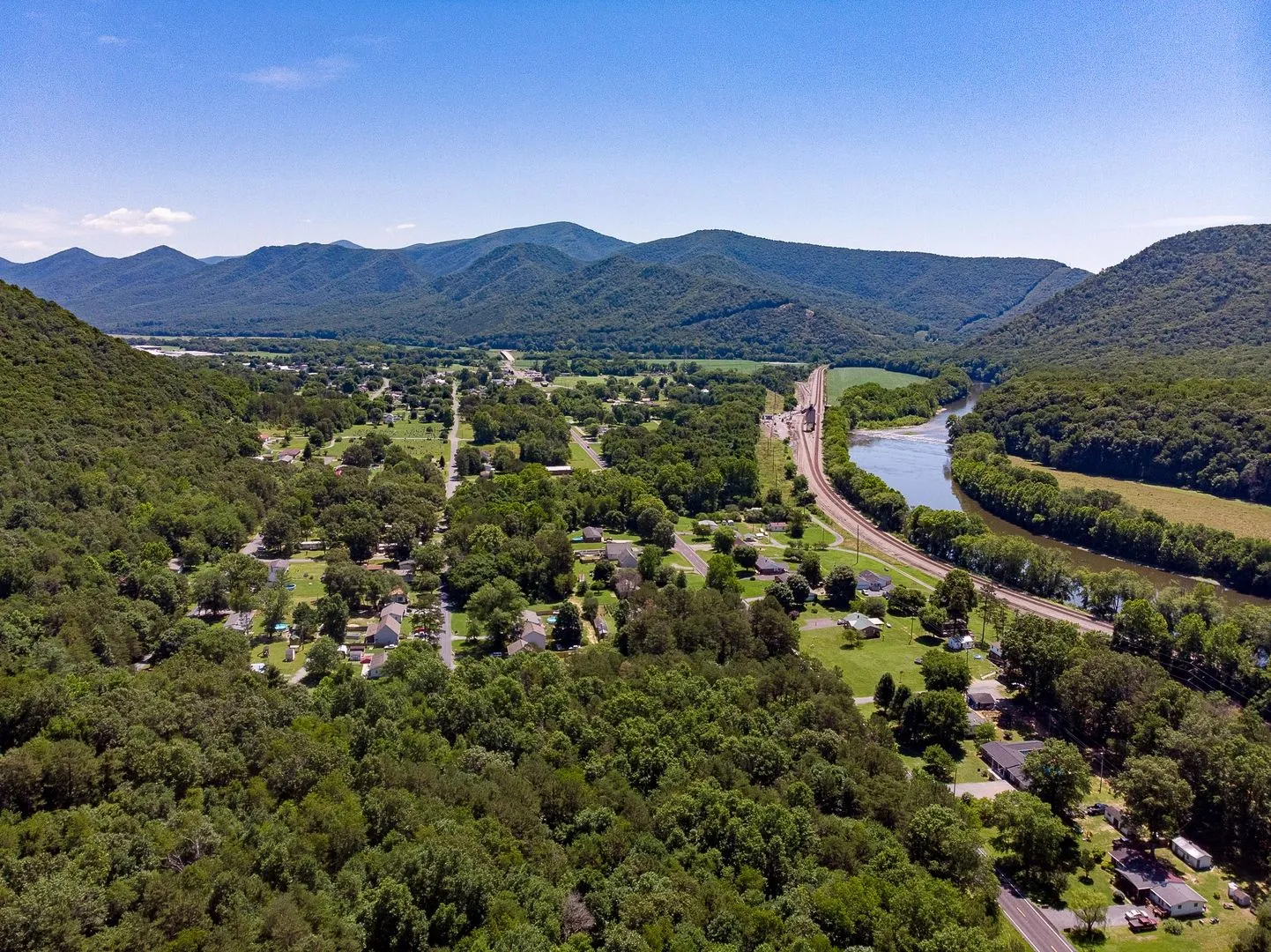
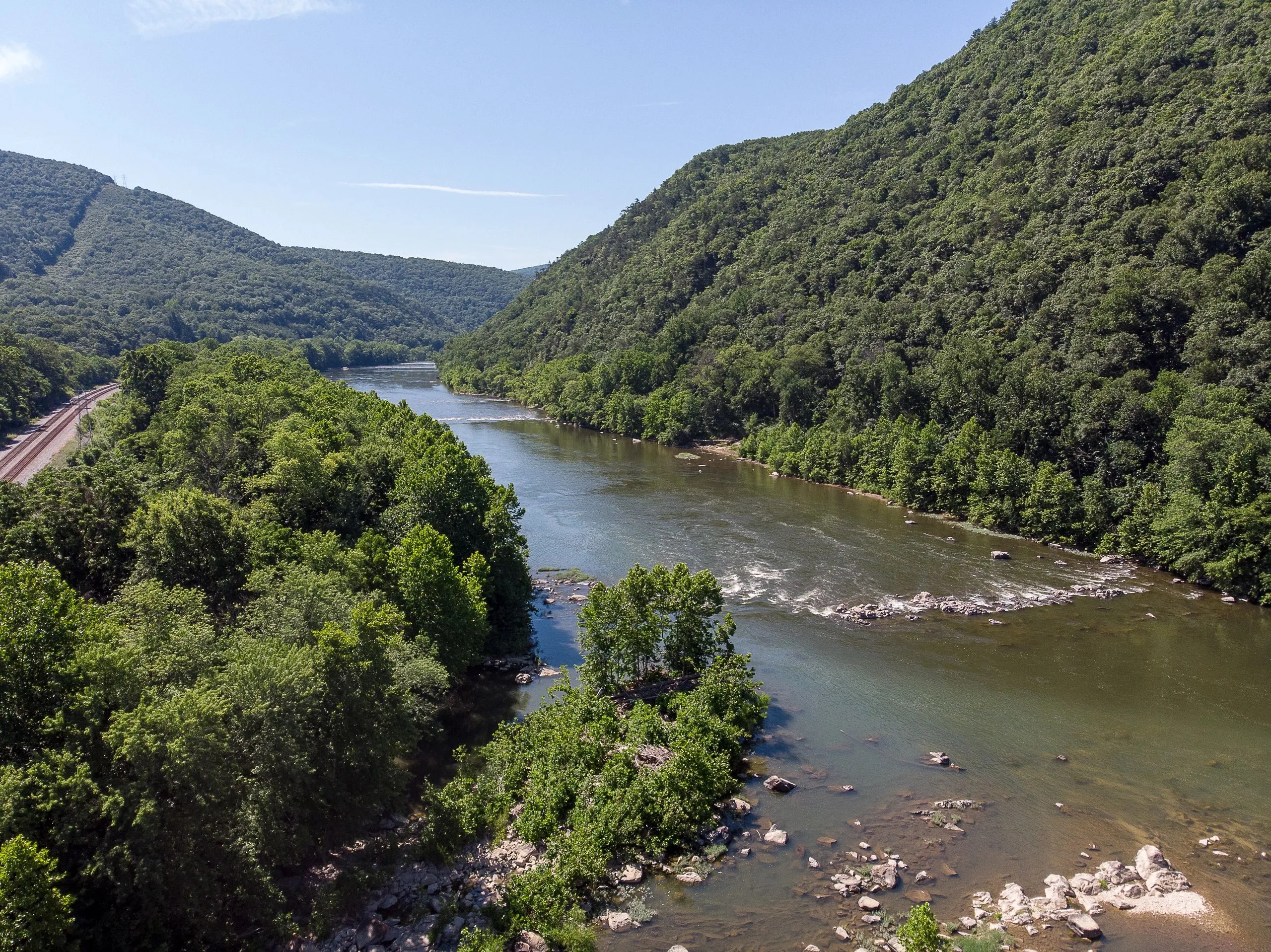
Glasgow, Virginia nestles between the foothills of the Blue Ridge Mountains, bounded by the James and Maury Rivers in Rockbridge County. Early settlers, filled with dreams and hopes, arrived in this land of promise as early as the 1730s.
The Natural Bridge of Virginia — one of the seven natural wonders of the world — is just six miles down the road. Over the years, natural and economic disasters often forced the dreamers into reality laden with tragedy and devastation, but the sturdy Scots-Irish immigrants persevered, as do the people of Glasgow today.
Glasgow, once thought to be destined to become the City of the South with its two rivers, improved water travel to the state capitals at Williamsburg and Richmond and the Tidewater ports. The Kanawha Canal, built along the James in the first half of the 19th century, and the North River Navigation Canal (along what is now the Maury River) permitted shipping to and from Lexington, 20 miles to the north.
In 1881 two railroads converged here, making Glasgow a hub of transportation. Today two railroads — Norfolk Southern (once the Shenandoah Valley Railroad) and CSX (the old Richmond and Allegheny) — switch freight between their lines at Glasgow. The mountains surrounding Glasgow, with deposits of iron ore, manganese, and natural cement, also gave promise of industry and development. This promise gave way to the great boom of the 1890s.
John Peter Salling was the first to settle in what is known today as Glasgow, around 1741. He and his brother Peter A. Salling settled and farmed the prime bottom land. Around 1760 John Paxton II acquired a great deal of the Salling property and acquired more in 1768 from heirs of Salling’s family.
The history below is drawn from One Hundred Years of Dreams by Lynda Miller, used with permission of the author. The Town of Glasgow is grateful for her work documenting the community’s story.
A fight at Glasgow, 1742
A battle between the colonial militia company and the Iroquois took place near the mouth of the North River (Maury River) on December 18, 1742. Captain John Buchanan and Captain John McDowell commanded the local company.
The story has it that 33 Iroquois were passing through the Borden Tract. Complaints were made and Colonel Patton gave the order to move the Iroquois on elsewhere. McDowell and 34 other men overtook the Iroquois just beyond the Salling Plantation. A 45-minute battle ensued and in the end the Iroquois took to the mountains. The death toll was 11 settlers, including McDowell, and eight to nine Iroquois.
A historical marker commemorating the event is located beside Route 130 in Glasgow.
The Glasgow brothers and the town’s name
Three brothers — Robert, Joseph, and Arthur Glasgow — settled in the valley in 1768. In 1782, Arthur Glasgow received a grant from the McNutt family for the land. He never settled there, but he willed it to his son Joseph Glasgow in 1822.
Glasgow received its name from Joseph Glasgow, the first member of the family to live in Glasgow. Joseph and his wife Nancy Ellis McCullough built their home in 1823. The house was known as Union Ridge and it stood at 1005 Fitz Lee Street until 1986. Union Ridge consisted of a house and 641 acres and was willed to Elizabeth Glasgow Johns, who sold most of the 641 acres to the Rockbridge Company in 1890.
Industry and the canals
In the mid-19th century, Glasgow’s natural resources and convenient location attracted men who dreamed of development. A cement plant was established. The Kanawha Canal opened commerce east and west. Railroads arrived and businesses began to flourish.
In 1848, Charles Hess Locher came to Balcony Falls and founded the James River Cement Works. At the time, construction of the Kanawha Canal on the James River was going to improve river transportation. The James River Cement Works produced natural cement for most of Virginia until Portland cement, much superior in quality and strength, became widely available. Charles Locher’s two sons, Harry and Eben, ran the company after the Civil War until it closed in 1907.
After the factory closed, Charles’s fourth son, Charles Hunter Locher, began acquiring several thousand acres in the 1920s in Glasgow and the surrounding area and incorporated them under the name of the Glasgow Company. Part of this land was sold to James Lees and Sons Company as a factory site in 1934. Locher also founded the Locher Clay Products Company, producing brick. General Shale later took over the Locher Company. Today the brick company remains closed.
The boom of the 1890s
Glasgow had planned to be the City of the South because of what it had to offer. In the 1890s what else could a city ask for: two rivers, two railroads, and an abundance of natural resources. Glasgow was prime real estate. Three companies were to lead Glasgow’s development — the Rockbridge Company, the Glasgow Improvement Company, and the West End Company.
In the early 1890s a real estate boom hit the country; two towns, Buena Vista and Glasgow, were laid out and chartered with the speculation that they would become an important part of the country’s great industrial movement. Glasgow was officially born on March 5, 1890 — the day the Rockbridge Company held a drawing of lots. At that time only two houses — Union Ridge and the Salling home — stood in Glasgow, which then boasted a population of no more than 20 people. The city, which was to have been three miles long, was to extend up to present-day Natural Bridge Station. It was laid out with broad avenues, well-graded boulevards, and handsome drives. Seven miles of streets were graded, with Rockbridge Road (today’s Route 130) being 125 feet wide. Plank sidewalks were placed along many streets. Glasgow attracted investors from all parts of the country and abroad, as well as local folk. The growth of Glasgow was phenomenal.
An investment of $1,500,000 by a British syndicate, to be used in improving and developing this city, in addition to about an equal amount already realized by the Rockbridge Company from sale of its stocks and lots, gave the town an impetus second to no other new town of the South. Fitzhugh Lee, President of the Rockbridge Company and grandson of General Light Horse Harry Lee, became Governor of Virginia in 1886. During his last year in office, Fitz Lee was asked to serve as President of the Rockbridge Company. While in Glasgow, the family lived in the home now known as Virginia Manor. By June 1890, 55 houses stood in Glasgow. By October 25, 1890, the population was over 800, with 12 factories and industries operating or under construction.
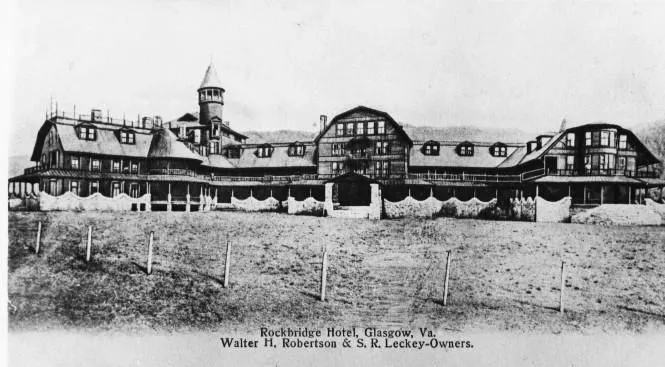
A shining symbol of the anticipated success of the Rockbridge Company was the Rockbridge Hotel, a glittering reflection of those exciting times.
The bust
On September 17, 1892, a procession of fine polished carriages began to arrive at Glasgow’s mammoth Rockbridge Hotel. People from across the nation and from more than a dozen foreign countries attended the opening night gala. The hotel had more than 200 rooms and suites in the Queen Anne style. A roof garden, a daring architectural innovation in the 1890s, reflected the dazzling mood of its creators.
That same night, soon after the guests departed, the failure of the Baring Brothers International Bankers set off an alarm that was soon felt across the Atlantic. The economic Panic of 1893 put the Rockbridge Company out of business. The panic, caused by the failure of the Reading Railroad, was magnified by the failures of hundreds of banks and businesses dependent upon the railroads. The United States Treasury experienced a drain on its gold reserves that developed into a full-fledged panic in 1893. The Rockbridge Company’s stock and land values plummeted, and the company failed.
With the end of the Rockbridge Company, plans for Glasgow’s development ended. The hotel sat vacant and was the subject of court actions for over 14 years. It was finally sold to a group of businessmen for a mere $10,000 — barely enough to pay the watchman’s wages. The land was eventually purchased by James Lees & Sons, which built homes on the site.
After the bust
The failure of local businesses was a sign of the depression that gripped the nation from 1893 until around 1897. Glasgow survived as most other towns did — by doing the best they could. James River Cement Works, one of the area’s major industries, survived the bust only to close in 1907. Later came the Locher Clay Products Company and then General Shale Brick.
The Virginia Electrical Power Company (VEPCO) built a hydroelectric plant at Balcony Falls in 1915 to meet the electric needs of the area. The plant operated until 1969. The dam provided many recreational opportunities on the James and Maury Rivers. Citing concerns that the devastating flood of 1969 probably would not have been as bad if the dam were not there, citizens of Glasgow petitioned to have the dam removed. In 1974, VEPCO removed it.
The carpet mill era
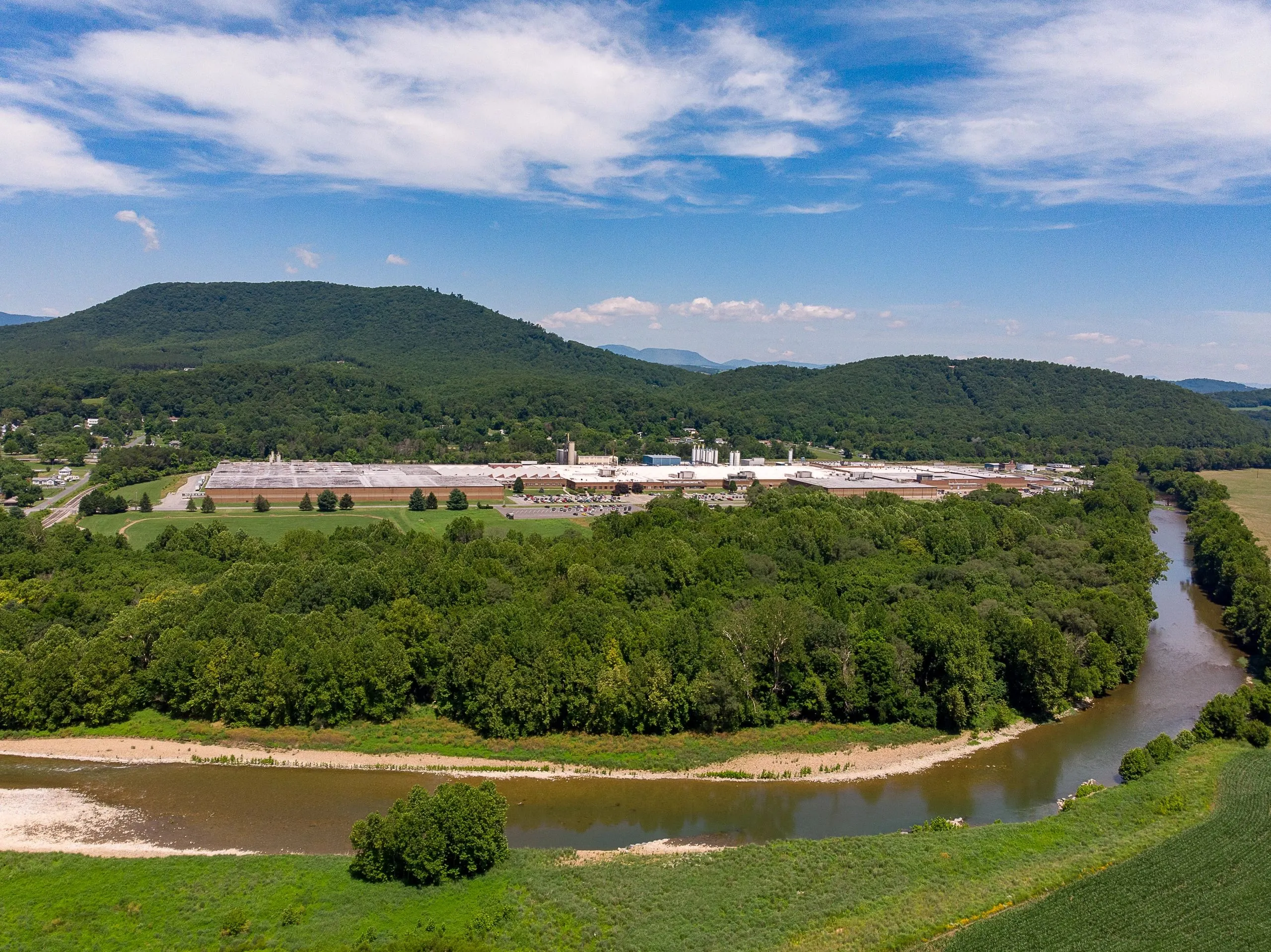
In 1934, the Blue Ridge Company (James Lees & Sons) built a carpet weaving plant on about 100 acres of land bordered by the Maury River. Production of carpet started in July 1935 and the first order was shipped on September 10, 1935. By the end of 1936 the weaving mill had doubled in size, and James Lees & Sons began construction of Axminster Mill in 1941. With the United States entry into World War II, construction was not completed until 1945. During the war years, the plant went from producing carpet to producing canvas duct for the armed forces. Four hundred women took the place of the men who left to fight in the war. During that time the plant ran 24 hours a day, seven days a week.
From 1948 to 1953 additions were made to the Wilton, Velvet, and Axminster mills, and an industrial waste plant was built to curb pollution flowing into the Maury River. In 1954, the plant doubled the size of the yarn mill. In 1960, James Lees & Sons became part of Burlington Industries, then the largest textile manufacturer in the world.
In 2002, Burlington Industries filed for bankruptcy and Mohawk Industries purchased the Lees Carpet facility. The 1.5-million-square-foot facility (34 acres) is the largest carpet manufacturing plant under one roof in the United States. Mohawk Industries operates the plant 24 hours a day.
Frank Padget
Heavy rains in late January 1854 left the James River and the treacherous Balcony Falls in full flood. On January 21, the canal boat Clinton and its passengers became stranded in the raging waters. Frank Padget, a skilled boatman and slave, led four other men to rescue them. In a heroic attempt to save the last passenger, Padget drowned, unable to fight the rushing current.
Captain Edward Echols, who witnessed Padget’s act, was so moved that he commissioned the construction of a granite obelisk monument beside lock 16 of the Blue Ridge canal. It now stands in Glasgow’s Centennial Park. Padget, an African-American resident, saved many lives before losing his own — a story of selfless action in the face of grave danger.
The floods
Two major rivers — the Maury and the James — and Salling Mountain surround Glasgow, making the Town prone to flooding. The earliest recorded flood occurred in 1877. Other recorded floods include 1936, 1950, 1969, 1972, 1985, and 1995. The floods of 1936, 1969, and 1985 were the worst.
The flood of 1936 was particularly devastating because there were many new residents living in town at the time, due to the opening of the new carpet factory. The flood was caused by rain from the remnants of Hurricane Hazel. More than four inches of rain fell in a two-day period on already saturated ground. The James crested at 11:00 PM on March 17. Locher’s brick plant was several feet under water, as was the Greenlee Bridge in Natural Bridge Station. In Buchanan, the James crested at 26.8 feet — 9.8 feet above flood stage.
The flood of 1969 seems to be the flood that most Glasgow residents say was the worst in history. Remnants of Hurricane Camille dumped an average of 12 to 20 inches of rain in a 3-to-5-hour period in the mountains of Virginia. The ensuing flash floods took the lives of more than 117 Virginia residents. Seven of those killed came from the Glasgow area. The James River in Buchanan crested at 23.4 feet (6.4 above flood stage); the Maury River crested at a record 31.2 feet in Buena Vista (14.2 feet above flood stage).
The flood of 1985, known as the Election Day flood, was caused by the remnants of Hurricane Juan on November 4. Roanoke recorded a record 6.63 inches of rain in 24 hours and it rained continually for six days. The James flood level in Buchanan was a record 38.8 feet (21.8 feet above flood stage).
Flooding in Glasgow, although causing significant damage, was probably reduced by the removal of the Balcony Falls dam. Citizens of Glasgow have endured a lot during each flood, but each time they have come back stronger.
Flood mitigation
After the June 1995 floods, Glasgow embarked on an ambitious project to address the problem of properties damaged repeatedly by flooding and yet repaired or rebuilt in the same unsafe locations. Fifty-six houses were identified as receiving substantial and recurrent flood damage and were slated for elevation, relocation, or acquisition and demolition.
Funding for this $2.5 million project came from FEMA’s Hazard Mitigation Grant Program, the Virginia Department of Housing and Community Development, the Virginia Department of Emergency Management, Rockbridge County, and the Town of Glasgow. As a result of this project — completed in 2003 — more than 100 people are protected from future damaging floods. The project, administered in town by Mayor Sam Blackburn, drew on Central Shenandoah Planning District Commission staff Rebecca Joyce and Bonnie Riedesel, with engineering by Engineering Concepts, Inc. of Fincastle.